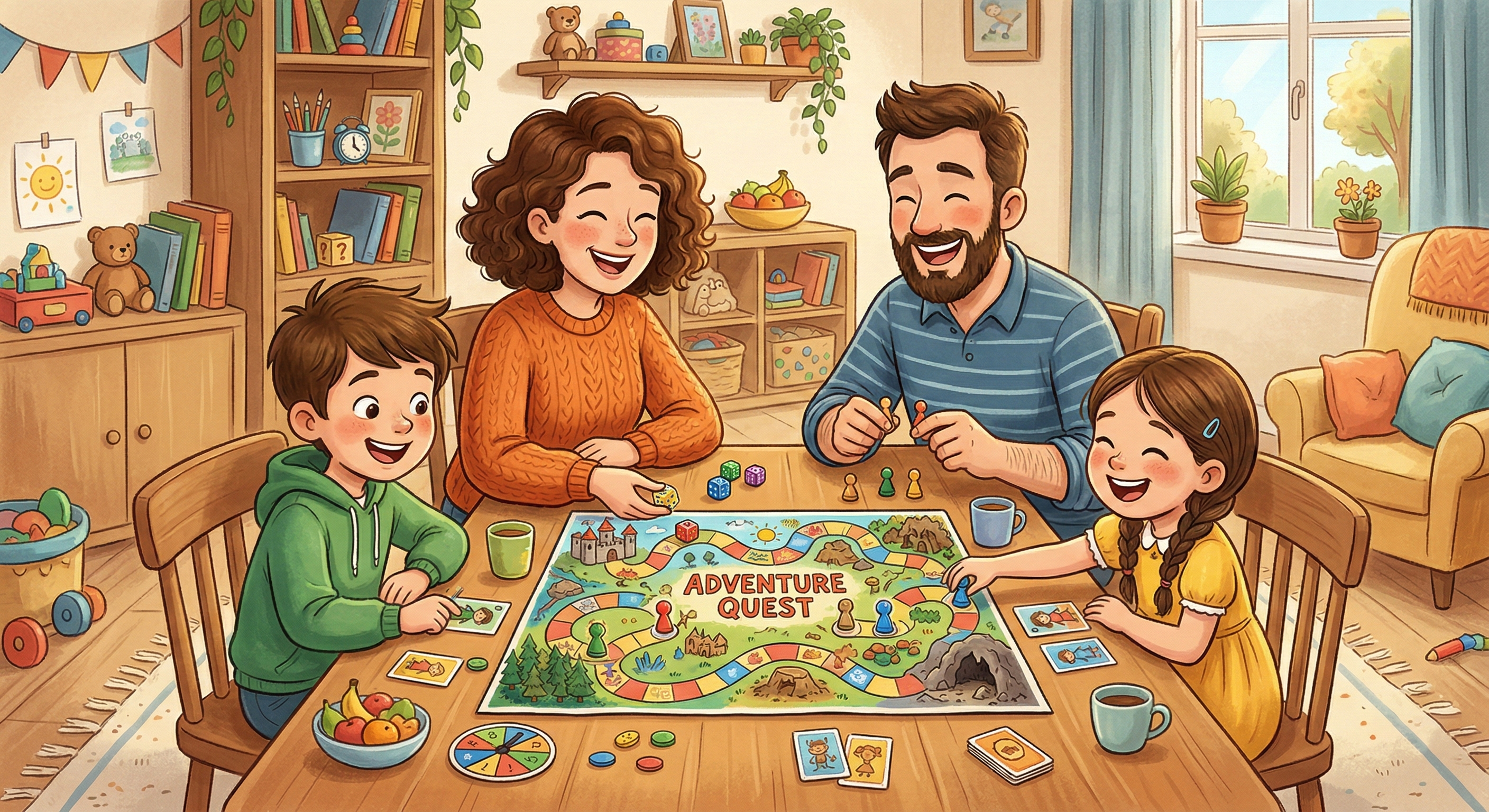
While Slimes provides the best digital RPG experience for students, we believe kids still need physical play to truly wire knowledge to context. Here are some tactile games you can play in your living room to reinforce what they learned on the screen.
Learning a new language shouldn't be confined strictly to the classroom or a digital device. The science of learning suggests that information retention is far more powerful when associated with physical and spatial experiences. By involving the body and movement, the brain creates more robust and lasting memory anchors.
Integrating physical play into the home study routine reduces the stress associated with language acquisition. When a child is having fun and moving, the affective filter drops, allowing information to flow without the psychological barriers of traditional education. These play moments become the perfect extension of their progress in the world of Slimes.
Below, we present three neuroscience-backed strategies to transform your home into a living language lab, where every object and corner becomes an opportunity to practice without it feeling like schoolwork.
"Babies don't learn from memorizing lists; why should children and adults? Language learning should not involve any stress.
Sticky Note Scavenger Hunt
This activity uses contextual mapping to turn the home into a giant dictionary. By labeling common household items and having the child hunt for the 'red chair' or the 'kitchen clock' in the target language, we are linking the abstract concept with a real physical location. This exercise doesn't just reinforce vocabulary; it trains spatial memory. The child's brain will remember the word not just for its sound, but for the physical effort of finding the object, creating a dual neural connection that is extremely hard to forget.
'Simon Says' with Action Verbs
Based on the TPR (Total Physical Response) method, this game uses body movement to process grammar. When a child must jump, run, or touch their nose following instructions, they are processing the language directly through their motor skills, bypassing mental translation. It is one of the fastest ways to reach fluency. The central nervous system becomes the direct receiver of the language, eliminating the cognitive fatigue of paper-and-pencil exercises and replacing it with an instinctive, natural response that mimics how we acquire our native tongue.
Pictionary with a Semantic Twist
Drawing a concept forces the brain to perform deep semantic processing. The child must deconstruct the meaning of a word to represent it visually, which activates the right hemisphere and reinforces conceptual understanding beyond simple literal translation. By adding challenges, like drawing with eyes closed or under time pressure, we introduce a 'desirable difficulty' that increases attention. This multimedia learning technique ensures the word is stored both verbally and visually, doubling the chances of future recall.
The key to linguistic success is constant association. By combining the scientific rigor of Slimes with physical play at home, we guarantee that the new language isn't something the child 'studies,' but something they 'live' and enjoy every day.